A World Alzheimer’s Month Special for Quantum University
By Dr. Patrick K. Porter
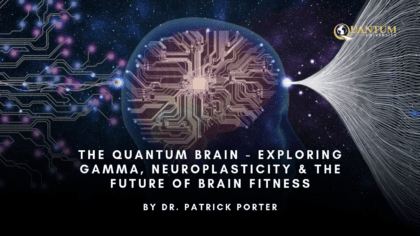
During World Alzheimer’s Month, there may be no better time to reconsider one of our most important assumptions about aging: the brain is not simply a static organ destined to decline. It remains dynamic, electrical, and capable of adaptation.
Emerging research on gamma-frequency stimulation is adding an intriguing dimension to that conversation. BrainTap’s scientific literature review includes studies on brainwave entrainment, cognition, and 40-Hz gamma stimulation.
BrainTap’s technology is built on a related principle: using precisely orchestrated light and sound to encourage the brain’s natural frequency-following response. Its technical review defines entrainment as the synchronization of neural activity with rhythmic external stimulation.
What We Observed With BrainTap
One particularly interesting BrainTap investigation combined audiovisual brainwave entrainment with Dr. Kelly Miller’s Saving Your Brain therapeutic approach. BrainTap’s research materials describe this work as examining changes in quantitative EEG alongside cognitive and emotional assessments.
The results encouraged us to continue asking a much bigger question:
What happens when we deliberately give the brain the rhythmic information it needs to reorganize?
That question also aligns with exploratory observations we made while mapping veterans participating in psychedelic-assisted psilocybin experiences. We observed substantial gamma activity during these experiences. Some veterans used BrainTap as part of integration, while others who chose not to use psilocybin participated in gamma-oriented BrainTap light, sound and vibration sessions. Some reported experiences similar to those described during psychedelic sessions.
From Chemistry to Frequency
For decades, discussions of brain health have focused heavily on chemistry—neurotransmitters, hormones, medications, and molecular pathways. Yet brain function begins with an extraordinarily complex electrochemical signaling system. Electrical activity and chemical signaling are deeply interconnected: neuronal electrical activity can trigger neurotransmitter release, while neurotransmitters, in turn, modify subsequent electrical activity.
This distinction matters. Rather than viewing brain chemistry in isolation, we can begin thinking about the brain as an integrated electrical, chemical, and rhythmic network.
That is where the quantum conversation becomes especially interesting.
BrainTap’s technical literature describes brainwaves as rhythmic patterns of neural electrical activity measured by EEG and explains that external rhythmic stimulation can influence neural oscillations through brainwave entrainment.
The BrainTap literature review describes the spectrum from delta and theta through alpha, beta, and gamma and examines research into auditory and visual stimulation of these rhythms.
This gives us a fascinating framework: influence the brain’s electrical rhythms, and downstream physiological and chemical processes may also change.
What might we discover as we learn to work intentionally with the brain’s natural electrical rhythms (the brain’s frequencies)?
Become the Researcher of Your Own Brain
At Quantum University, we learn that transformation begins with curiosity, observation, and experience.
So rather than simply reading about brain fitness, consider conducting your own 14-day personal wellness experiment. Establish your baseline—sleep quality, perceived stress, focus, energy and mental clarity—then use BrainTap consistently and observe what changes.
Keep a journal. Track your experience. Pay attention to your sleep, recovery, focus, and resilience.
Perhaps one of the most exciting questions in brain fitness isn’t simply “What does the research say?”
It is: What will you discover when you become an active participant in your brain-fitness journey?